Incredible dancers in new roles: The Joyce Ballet Festival 2026
Our take
The Joyce Ballet Festival 2026, curated by Misty Copeland, feels like a monumental shift, a necessary recalibration within the dance world. Copeland’s selection of eight dances, specifically spotlighting Black, Brown, and queer artists, is a powerful statement against the historical and persistent dominance of whiteness in ballet. It’s refreshing, yes, as the article notes, but it’s also a long-overdue correction. We’ve seen glimpses of this change before, like the community performances highlighted in [A hard place to land: Dancing on concrete], where joy and accessibility are paramount, and it’s incredibly inspiring to see it gaining further prominence on a major stage. This festival echoes the kind of forward-thinking programming exemplified by L’Alliance New York’s Crossing The Line Festival [L’Alliance New York’s Crossing The Line Festival], which champions international perspectives and pushes boundaries – a spirit of exploration that's vital for the evolution of dance. The sheer act of centering marginalized voices isn't just about representation; it’s about expanding the very definition of what ballet *is* and what stories it can tell.
For years, the rigid structures and traditional aesthetics of ballet have created barriers to entry and often silenced diverse narratives. Copeland’s curation directly addresses this, acknowledging that the beauty and power of movement aren't confined to a single aesthetic or a single body type. It's a testament to her own journey, breaking barriers as a Black principal dancer at ABT, and a clear signal that the future of ballet is one of inclusivity and vibrant expression. As a performer, a mom, and someone who believes wholeheartedly in the power of feeling confident in your own skin, I see this as incredibly validating. It’s about more than just technique; it’s about inhabiting your body with strength, grace, and self-assurance – qualities I cultivate daily, whether I’m supporting my family, working on the pole, or just feeling fabulous in my own skin. The discipline and artistry required for ballet translates beautifully to other forms of expression, and to see that acknowledged on such a prominent platform is truly exciting.
The broader significance of this festival extends beyond the immediate performances. It sends a message to young dancers, particularly those from underrepresented communities, that their stories matter and their voices deserve to be heard. It challenges established institutions to examine their own biases and actively create space for diverse talent. It’s a ripple effect, encouraging a more equitable and representative dance landscape across the board. And let’s be honest, a more diverse dance world is a richer, more compelling world. Thinking about the commitment to growth and development within organizations like BodyVox [BodyVox announces new Director of Individual Giving and leadership updates for 2026-27] further highlights a positive trend of actively fostering inclusivity and supporting new leadership. These are the kinds of changes that build a sustainable and vibrant future for the arts.
Ultimately, the Joyce Ballet Festival 2026 under Copeland’s curation represents a pivotal moment. It’s not just a celebration of dance; it's a declaration of change. It’s a reminder that art should reflect the complexity and beauty of the human experience, in all its forms. As we move forward, the question becomes: How will other institutions respond? Will they embrace this shift towards inclusivity, or will they cling to outdated traditions? The answer will shape the future of dance, and the answer will resonate far beyond the stage.
The Joyce Theater, New York, NY.
August 5, 2026.
The Joyce Theater once again hosted the annual The Joyce Ballet Festival, a two-week run celebrating a particular aspect of ballet. Misty Copeland, American Ballet Theatre (ABT)’s recently retired star and long-time advocate of inclusivity in ballet, curated this year’s two-week stay at the theater. Copeland selected eight dances for the first week, centering black, brown and queer artists. In a world heavily centered on whiteness, it was a refreshing change.
The show opened with Interactions, by Ingrid Silva, and featured pulsating, driving music, combative and powerful movement that shifted seamlessly from pedestrian forms to ballet. Lighting by Carolyn Wong and costumes by Erica Johnston added a steady richness to the intensity of the work.
Next, we went back in time to 1978 Bob Fosse era with Percussion IV, performed technically brilliantly by Shota Miyoshi of Hubbard Street Dance Chicago. Clean, crisp and with a sprinkle of diva power, it was a joy to watch. An excerpt from Young Lovers by Houston Thomas was next, the second duet for two men of the evening. It was emotional and serious with vague smoke filling the stage, but the depth eluded me.
Sonata For Two Cellos closed the first half, choreographed by José Limón in 1961, and danced by newly minted New York City Ballet (NYCB) Soloist Victor Abreu. The work evolved significantly as the piece went on, drinking from an ever deeper well and growing in the extreme, but executed with the surety of perennial reed, roots buried deeply beneath it, letting it move freely and curiously. Abreu’s shirt became more untucked and disheveled over time, adding to the humanity.
We came back from intermission to Ave Maria, the 1995 work by Dwight Rhoden on Complexions Contemporary Ballet. The duet had all the spectacle, all the high kicks and big arms, and a lengthy balance in second position grand plié en pointe. It was flashy, and people seemed to like it.
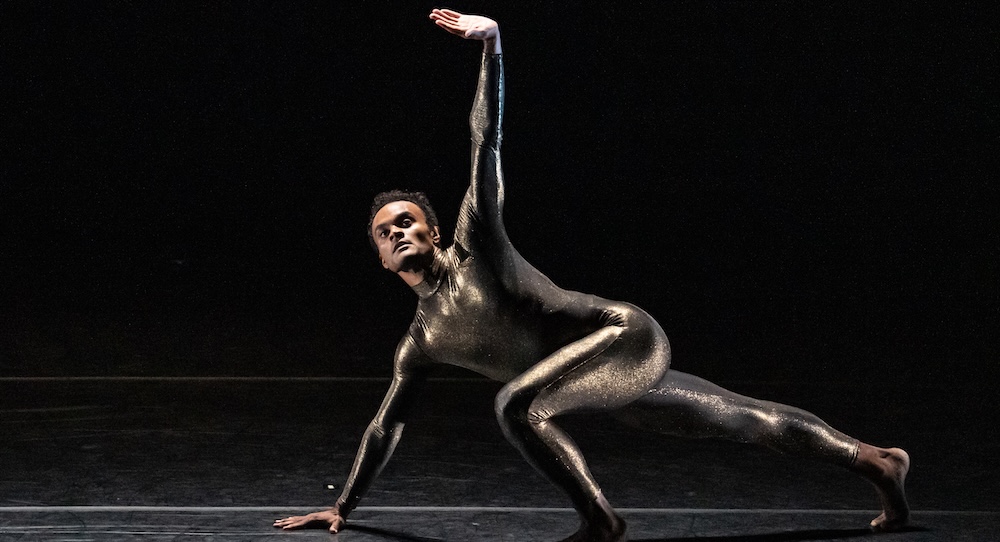
Next, we saw “a match made in dance heaven,” quoted verbatim by the woman behind me. Taylor Stanley of NYCB performing Kyle Abraham’s Show Pony was truly fluid magic. The 2018 work was delivered by Stanley with veteran calm and security, and a fearlessness that made the playful, the absurd, and the benign equally compelling. The skill required to move through the choreography with such cool almost seemed un-human-like, but in a gold metallically-clad good way.
The shift from this piece to the next was jarring, despite the technical and artistic mastery of Paris Opera Ballet Étoiles Guillaume Diop and Sae Eun Park. Performing the balcony scene from Romeo and Juliet without the balcony right after watching Show Pony took a big mental leap, although one I was personally willing to take to witness the incredible and pristine work of these dancers. Lastly, we saw Rising by Aleisha Walker, for five women. It was a very well danced contemporary ballet offering and wonderful to see the women of Dance Theatre of Harlem and ABT dance together.
This year’s Ballet Festival had a wide array to offer, even if the programming was clumsy at times. It’s a treat to see so many world class dancers onstage, and the August timing between seasons gives audiences the opportunity to watch so many incredible dancers in roles they may not otherwise have the chance to explore.
By Emily Sarkissian of Dance Informa.
The post Incredible dancers in new roles: The Joyce Ballet Festival 2026 appeared first on Dance Informa Magazine.
Read on the original site
Open the publisher's page for the full experience